Sunset Times on Maui by Month: The 2026 Table
Ninety minutes separate the earliest sunset of the year from the latest. Hawaii never shifts its clocks, so that ninety minutes is the whole story, and every departure time on the island is built backwards from it.
Short answer
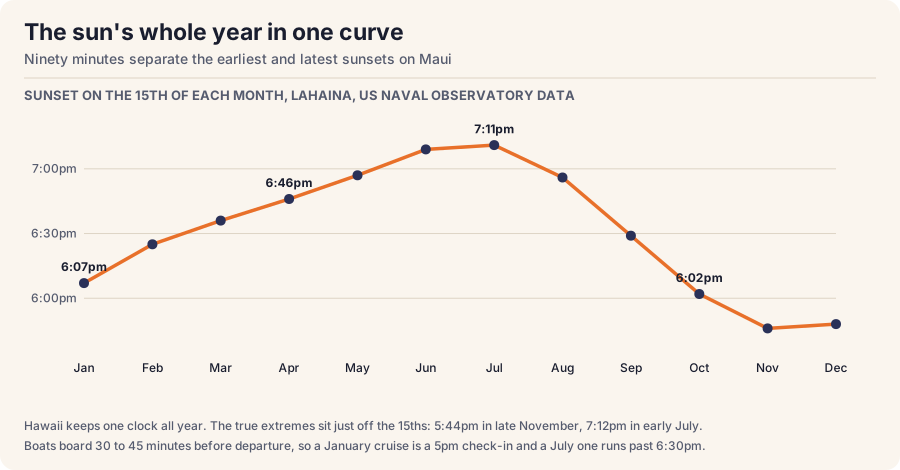
Maui sunsets run from 5:44pm in late November to 7:12pm in early July, a ninety-minute range with no daylight saving to complicate it. On the 15th of each month: January 6:07pm, April 6:46pm, July 7:11pm, October 6:02pm. Boats time departure so the drop lands in the back half of the sailing, and check-in opens 30 to 45 minutes ahead.
At 5:44pm in the last week of November the sun hits the water off Lahaina, and that is the earliest it will do so all year. Seven months later, in the first days of July, the same event happens at 7:12pm. Between those two numbers sits every dinner reservation, every check-in window and every departure time on this island, because nobody schedules an evening on the water without first knowing when the light goes. The long June and July evenings even leave room for the all-day Road to Hana loop before a late boat; check dates for the small-group Hana tour here if you want to stack the two.
Hawaii's advantage is that the number never lies to you. No daylight saving, no spring-forward, no October morning where suddenly everything is an hour off. The sun moves gradually, predictably, and by less than most visitors assume: ninety minutes of annual swing against the four or five hours a mainland city deals with.
What time does the sun set on Maui each month?
Between 5:44pm and 7:12pm depending on the date. Taking the 15th of each month at the Lahaina coordinates: January 6:07pm, February 6:25pm, March 6:36pm, April 6:46pm, May 6:57pm, June 7:09pm, July 7:11pm, August 6:56pm, September 6:29pm, October 6:02pm, November 5:46pm and December 5:48pm.
The table below adds the three columns people actually need alongside the sunset time: when the good light starts, when the colour finally goes, and when a two-hour sailing typically leaves in order to put the drop in the right place. Departure and check-in figures are the pattern the fleet works to rather than any one operator's timetable, so confirm the exact time on the booking page before building a day around it.
| Month (15th) | Sunset | Golden light begins | Colour holds until | Typical 2h departure | Check-in opens |
|---|---|---|---|---|---|
| January | 6:07 pm | ~5:27 pm | ~6:30 pm | 4:40 to 5:10 pm | ~4:00 pm |
| February | 6:25 pm | ~5:45 pm | ~6:48 pm | 4:55 to 5:25 pm | ~4:15 pm |
| March | 6:36 pm | ~5:56 pm | ~6:59 pm | 5:05 to 5:35 pm | ~4:25 pm |
| April | 6:46 pm | ~6:06 pm | ~7:09 pm | 5:15 to 5:45 pm | ~4:35 pm |
| May | 6:57 pm | ~6:17 pm | ~7:20 pm | 5:25 to 5:55 pm | ~4:45 pm |
| June | 7:09 pm | ~6:29 pm | ~7:32 pm | 5:40 to 6:10 pm | ~5:00 pm |
| July | 7:11 pm | ~6:31 pm | ~7:34 pm | 5:40 to 6:10 pm | ~5:00 pm |
| August | 6:56 pm | ~6:16 pm | ~7:19 pm | 5:25 to 5:55 pm | ~4:45 pm |
| September | 6:29 pm | ~5:49 pm | ~6:52 pm | 5:00 to 5:30 pm | ~4:15 pm |
| October | 6:02 pm | ~5:22 pm | ~6:25 pm | 4:30 to 5:00 pm | ~3:50 pm |
| November | 5:46 pm | ~5:06 pm | ~6:09 pm | 4:15 to 4:45 pm | ~3:35 pm |
| December | 5:48 pm | ~5:08 pm | ~6:11 pm | 4:20 to 4:50 pm | ~3:35 pm |
Two dates in that year deserve their own line. The earliest sunset is not in December, which surprises almost everyone: it sits on a plateau from roughly 21 to 30 November, when the sun goes at 5:44pm every single evening. The latest runs on a similar plateau from about 2 to 11 July at 7:12pm. Solstice and sunset extreme are not the same day, and on Maui they are three weeks apart. The underlying figures come from the US Naval Observatory's annual sun tables.
Why do Maui sunset times move so little across the year?
Latitude. Maui sits at about 21 degrees north, close enough to the tropics that day length varies by roughly two and a half hours across the year instead of the six or seven a northern city sees. Add no daylight saving, and the sunset column shifts by ninety minutes total.
Compare it with somewhere familiar and the difference lands. Seattle's sunset swings by more than five hours between December and June, and then a clock change gets bolted on top. New York moves about four hours. Maui moves an hour and a half, and the clock never jumps, so a 6pm departure means the same thing in April that it meant in March.
The practical upshot is that a Maui trip does not need much recalculating. Book a boat for Tuesday and reschedule it to the following Sunday and the sunset has moved by perhaps four or five minutes. Shift it by a month and you are looking at ten to twenty. Only the November-to-January stretch is genuinely tight, because sunsets there sit below six o'clock and a late afternoon disappears faster than visitors expect.
The other consequence is less obvious and more useful. Because the sun tracks steeply at this latitude, twilight is short. Civil twilight, the window where there is still usable light after the disc has gone, runs roughly 22 to 25 minutes on Maui against 35 or 40 minutes in a temperate summer. The colour is intense and it does not linger, which is exactly why boats stay out for it and beaches empty before it. The vantage-point comparison in where the best sunset viewpoints sit works through what that means on land.
What time do the boats actually leave, and when is check-in?
Departure is set backwards from sunset, not from the clock. A two-hour sailing generally leaves 60 to 90 minutes before the drop so the sun lands in the back half. Check-in opens 30 to 45 minutes before departure, and the three departure points handle it very differently.
The check-in difference is the part that catches people out, because it is not a formality at every harbor. Kaanapali boats do not use a dock. They come to the beach, guests wade out, and boarding happens with wet feet, which means arriving on time is not optional and shoes come off before you get there. Lahaina and Maalaea are slip departures with a walk down a dock, which is easier but adds parking to the equation.
| Departure point | Where you check in | How you board | Arrive before departure | Parking |
|---|---|---|---|---|
| Kaanapali Beach, Whalers Village side | Beachfront kiosk at Whalers Village | Wade out to the boat, wet feet | 45 minutes | Paid resort structures, fills at sunset |
| Kaanapali Beach, Outrigger side | Aqualani kiosk oceanside of the Outrigger | Wade out to the boat, wet feet | 45 minutes | Paid, walk from the boardwalk |
| Kaanapali Beach, Leilani's lawn | Lawn between Leilani's and Ulu Kitchen | Short beach walk, then wade | 45 minutes | Paid resort structures |
| Lahaina Harbor | 116 Prison Street check-in | Dock and gangway | 30 to 45 minutes | Street and lot, phased harbor works ongoing |
| Maalaea, slips 56, 72 and 76 | At the slip | Dock and gangway | 30 to 45 minutes | Harbor lot, free but busy |
| Maalaea north dock | At the dock | Dock and gangway | 30 minutes | Harbor lot |
Sailing length changes where the sun lands in the trip. On a two-hour cocktail sail the boat gets out, positions, and the drop happens roughly two-thirds of the way through, leaving the afterglow for the run home. On a 2.5-hour dinner sailing, dinner is served first and the sun arrives partway through the meal. The single three-hour product in the fleet, the seasonal December-to-April dinner and whale watch, front-loads whale time and puts sunset near the end.
Departure times shift through the year as the sunset column moves, which means a boat leaving at 4:30pm in November is the same product leaving at 6:00pm in June. That is the number people get wrong when they plan from a summer visit. The specific published times are broken down in the departure times boats actually publish.
When does golden light start and when does the colour finally go?
Roughly 40 minutes before sunset the light turns warm and low. The last ten minutes are the strongest. The disc takes about two minutes to disappear once it touches the horizon, and civil twilight then runs another 22 to 25 minutes, with the deepest colour usually landing 10 to 20 minutes after the sun has gone.
That last sentence is the part beaches get wrong and boats get right. The sky does not do its best work while the sun is visible. It does it afterwards, when the light is coming from below the horizon and hitting the underside of whatever cloud is around. On a trade-wind evening with a low bank offshore, the ten minutes starting five minutes after sunset are frequently the strongest colour of the day.
| Phase | Relative to sunset | Duration on Maui | What it looks like |
|---|---|---|---|
| Late afternoon | 90 to 40 min before | ~50 min | Bright, still harsh, hats and sunglasses |
| Golden light begins | 40 min before | ~30 min | Warm, low, long shadows on deck |
| The last ten minutes | 10 min before | ~10 min | Strongest warm light, disc reddening |
| The drop | 0 | ~2 min | Disc touches the water and goes |
| First afterglow | 0 to 10 min after | ~10 min | Sky brightens rather than dims |
| Peak colour | 10 to 20 min after | ~10 min | Underlit cloud, the frame most people miss |
| Civil twilight ends | 22 to 25 min after | Ends abruptly | Usable light gone, horizon still bright |
| Blue hour | 25 to 45 min after | ~20 min | Deep blue, shoreline lights on, boats returning |
Steep sun angles are why this schedule is so tight. At 21 degrees north the sun goes down at close to a right angle to the horizon rather than sliding along it, so every phase is compressed. Anyone used to a long northern summer dusk will underestimate how fast it happens. Miss the twenty minutes after the drop and you have missed the best part of it.
Winter or summer: what actually changes besides the clock?
Everything except the boats. Winter buys early sunsets, humpbacks from November through May with peak abundance January to March, and cooler evenings. Summer buys the latest light of the year, the warmest water, and the strongest trade winds funnelling across the isthmus at Maalaea in the afternoon.
The seasonal split matters more than the ninety minutes of clock movement, because it changes what is actually happening around the sunset. A February sailing has whales in it. A July sailing has a 7:11pm drop and a warm deck at nine o'clock. Those are different evenings sold as the same product.
| Window | Sunset range | Whales | Wind and sea | Visitor pressure | Character |
|---|---|---|---|---|---|
| November to December | 5:44 to 5:50 pm | Returning, building | Moderate trades | Heavy over the holidays | Earliest departures, dinner ashore afterwards |
| January to February | 6:00 to 6:30 pm | Peak abundance | Winter swell possible on north shores | Very heavy | Whales and sunset in the same two hours |
| March to April | 6:35 to 6:50 pm | Peak tapering into late season | Settling | Heavy at spring break, thin after | Best all-round balance |
| May to June | 6:55 to 7:12 pm | Season closing out | Trades strengthening | Building | Latest light of the year |
| July to August | 6:55 to 7:12 pm | None | Strongest trades, windiest at Maalaea | Peak family travel | Warmest, breeziest, latest |
| September to October | 6:00 to 6:30 pm | None until late | Calmest of the year, lightest trades | Thinnest of the year | Quietest water, quietest beaches |
Whale season is the one seasonal factor that changes the product rather than the conditions. From November through May, and especially January through March, humpbacks are in the Auau Channel in numbers, and the federal rule keeps every vessel 100 yards away from them, so what you get is distance viewing rather than a close encounter. NOAA's sanctuary boating guidance sets out the approach limits every operator here works under, and the boats that build the season into the product are covered in sunset sails that double as whale watches.
One boat runs the combination as a dedicated seasonal product: a three-hour dinner and whale watch from Maalaea, December to April only, at 4.7 across 516 reviews. You can check which winter evenings the whale watch dinner still has open, keeping in mind it does not sail outside the season.
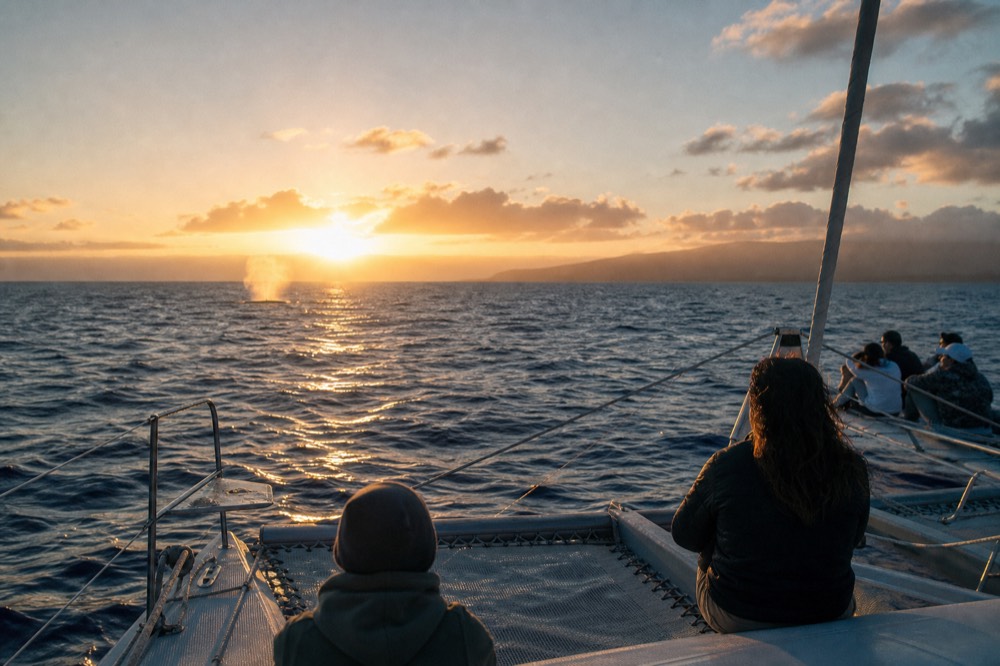
Do you eat before the sun drops or after?
It flips around October. From roughly October through February the sun is down before 6:30pm, a two-hour sailing is back at the dock by seven, and dinner ashore afterwards works easily. From May through August the drop is close to seven, a sailing returns near eight, and eating on the boat is the sane choice.
This is the single most useful piece of scheduling on the page, and almost nobody thinks about it until they are standing on a dock at eight in the evening in Maalaea wondering where is open. Restaurant kitchens on this island are not late-night operations. A 9pm arrival for a table is a gamble in most of Kihei and Lahaina.
| Month | Sunset | 2h sailing back around | Eat on the boat or ashore | Realistic dinner slot ashore |
|---|---|---|---|---|
| January | 6:07 pm | 6:45 pm | Either works | 7:15 pm, comfortable |
| February | 6:25 pm | 7:00 pm | Either works | 7:30 pm, comfortable |
| March | 6:36 pm | 7:10 pm | Either works | 7:45 pm |
| April | 6:46 pm | 7:20 pm | Leaning toward the boat | 8:00 pm |
| May | 6:57 pm | 7:30 pm | Eat on the boat | 8:15 pm, tight |
| June | 7:09 pm | 7:45 pm | Eat on the boat | 8:30 pm, tight |
| July | 7:11 pm | 7:45 pm | Eat on the boat | 8:30 pm, tight |
| August | 6:56 pm | 7:30 pm | Eat on the boat | 8:15 pm, tight |
| September | 6:29 pm | 7:05 pm | Either works | 7:45 pm |
| October | 6:02 pm | 6:40 pm | Either works | 7:15 pm, comfortable |
| November | 5:46 pm | 6:20 pm | Either works | 7:00 pm, easy |
| December | 5:48 pm | 6:25 pm | Either works | 7:00 pm, easy |
For summer evenings that argues for one of the plated and buffet dinner boats, where the meal and the sunset happen in the same two hours and nothing needs booking afterwards. The cheapest genuine dinner on the water runs three courses and two drinks from a double-deck boat out of Maalaea, rated 4.5 across 226 reviews. You can see current pricing on the three-course Maalaea dinner sailing and compare it against what a Wailea table costs on the same night.
In the winter months the calculation reverses, and a cocktail sail becomes the better value: two hours, drinks handled, back on the dock at 6:45pm with the whole evening still ahead of you. The open-bar options are laid out across cocktail sails with an open bar.
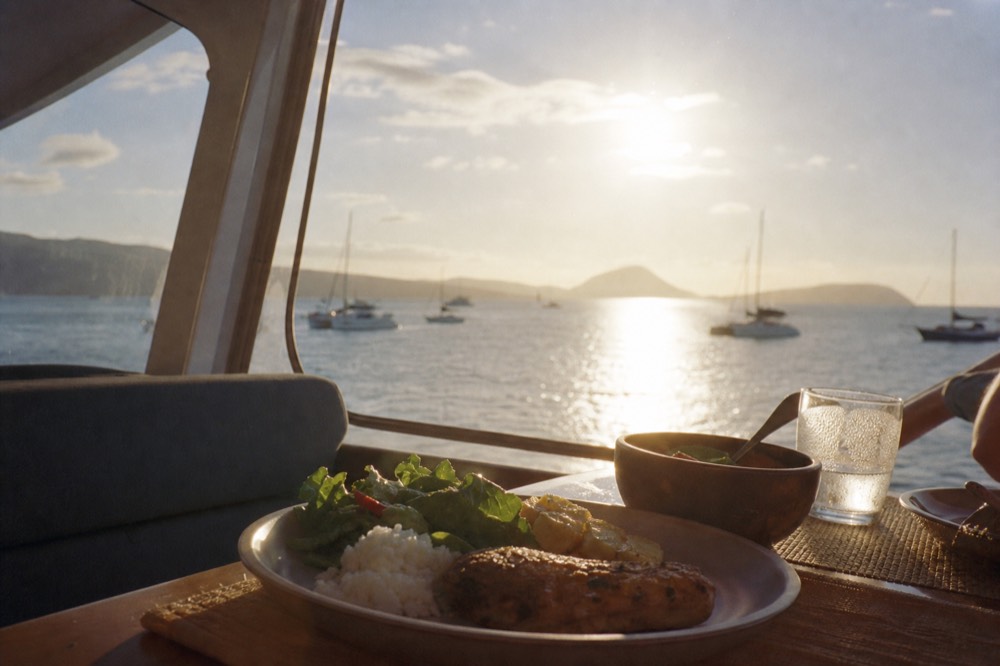
When should the camera come out?
Later than instinct suggests. The frames worth having start about ten minutes before the drop and run to about twenty minutes after it. The disc itself is the least interesting two minutes. Shooting into the sun before it reddens produces a white blob and a black deck, which is why so many sunset photos disappoint.
Timing beats equipment here by a wide margin. The reason phone photos of a Maui sunset so often look flat is that people shoot at the wrong moment: forty minutes early, when the sun is still bright enough to blow out the sensor and throw everything else into silhouette. Wait until the disc has reddened enough to look at directly and the exposure problem solves itself.
| The shot | When | Why then | Where to stand |
|---|---|---|---|
| Wide deck scene with people | 40 to 25 min before | Warm light still bright enough to expose faces | Amidships, sun behind the camera |
| Island silhouette | 15 to 5 min before | Ridgeline goes black against a bright sky | Bow or forward rail |
| Sun on the horizon | 2 min before to the drop | Disc is red enough not to blow out | Anywhere with a clear sightline |
| Green flash attempt | The final second | Needs a clean, cloud-free horizon | Highest point on deck |
| Rigging and sail silhouette | 0 to 8 min after | Sky is still bright, everything else is shape | Aft, looking forward |
| Peak colour sky | 10 to 20 min after | Underlit cloud, the best frame of the evening | Wherever the cloud is |
| Blue hour with shore lights | 25 to 45 min after | Boat is heading in, town is lighting up | Aft rail, facing land |
The other advantage a boat holds over a beach for photographs has nothing to do with light. It is the foreground. On the sand, every frame contains other people's heads and shoulders. On a deck a mile offshore, the bottom of the frame is water. That single fact is why the same phone produces different results in the two places, and it is covered from the viewing angle in the vantage-point comparison.
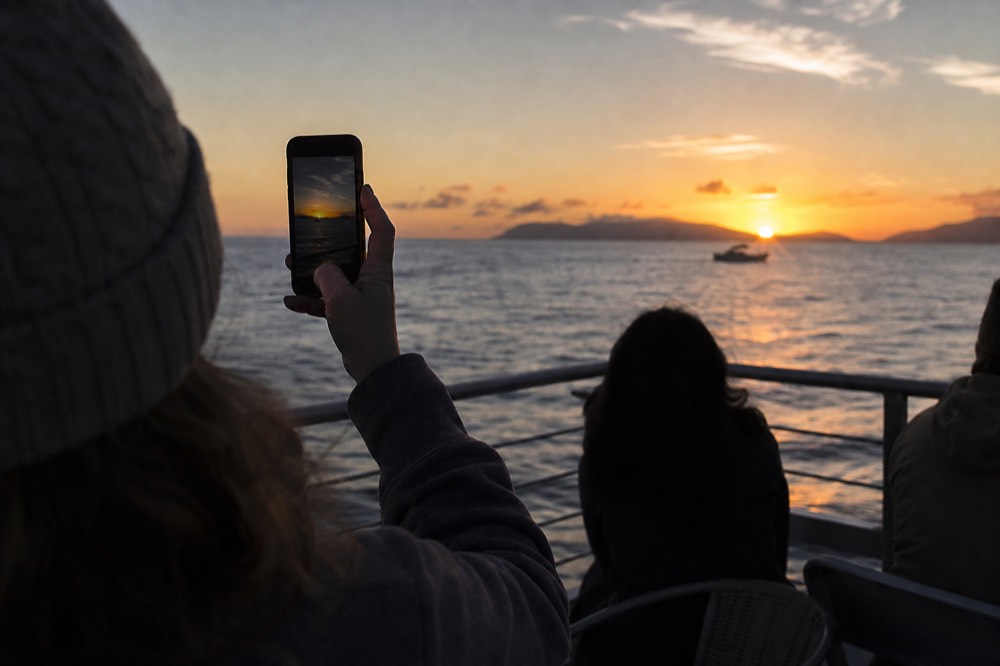
Which month suits which kind of evening?
September and October for the quietest water and thinnest crowds. January through March for whales in the same frame as the sunset. June and July for the latest light. November and December for the earliest departures, which suits families and anyone who wants dinner ashore afterwards.
Every month on this island produces a good sunset. What changes is everything around it, and the honest way to pick is to decide what the evening is for before looking at the calendar.
| If you want | Best months | Why | What to book |
|---|---|---|---|
| Whales in the frame | January to March | Peak humpback abundance in the channel | Seasonal dinner and whale watch, or any Maalaea sail |
| The latest possible light | June to early July | 7:09 to 7:12 pm drops | Dinner sailing, eat aboard |
| Calmest water | September to October | Lightest trades of the year | Any harbor, Maalaea included |
| The thinnest crowds | September, and April after spring break | Between the peak travel windows | Whatever has space, which is most things |
| Dinner ashore afterwards | October to February | Back at the dock before 7pm | Two-hour cocktail sail |
| An early evening with kids | November to January | Sunset before 6:10pm | Big-deck dinner boat from Maalaea |
| Warmest deck after dark | July to September | Warmest air and water of the year | Open-deck sail, lighter layer |
| Best value per hour | Any month | Fares do not move much by season | The $71 Maalaea sail or the $59.95 cocktail cruise |
That last row is worth pausing on, because it runs against expectation. Sunset fares on this island are not strongly seasonal in the way that lodging is. The same two-hour sail costs broadly the same in February as it does in September, which means the cheapest way to buy a good evening is not to chase a low season but to pick the right boat. The most-reviewed boat in the fleet, a two-hour open-bar cocktail sail off Kaanapali at 4.8 across 1,533 reviews, holds its position year round. Anyone weighing the Lahaina departures instead can check current dates for the 2.5-hour performance catamaran out of Lahaina, and the harbor's phased status is tracked across sailings out of Lahaina Harbor.
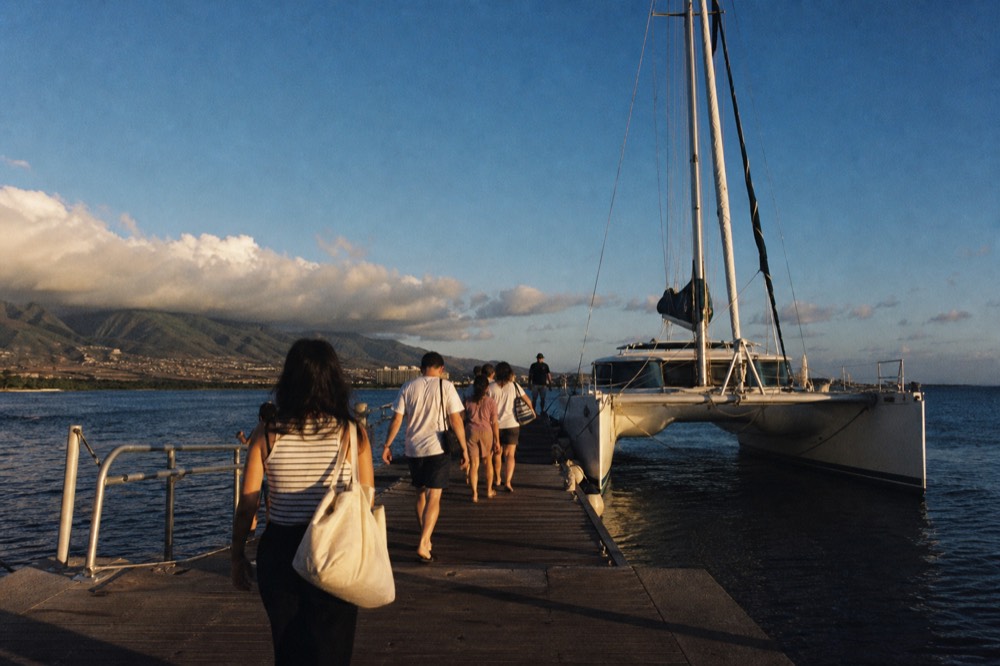
How far ahead should you book around the sunset date?
Two to four weeks through the peak windows, which run late December to March and June to August. A week is usually enough outside them. Every boat in the fleet carries free cancellation, typically to 24 hours before departure with one operator at 48, so booking early costs nothing to undo.
That cancellation policy changes the maths completely, and most people book as though it does not exist. If holding a seat is free to release, the optimal move is to take the date you want as soon as you know it and decide later whether the weather, the whales or the rest of the itinerary still make it the right evening. Waiting produces exactly one outcome that early booking does not: the boat is full.
Capacity is the reason the small boats go first. The floating tiki bar out of Maalaea caps at 40 guests. The luxury powerboat carries six, total, which makes it the fastest sellout in the fleet and roughly $1,500 if a group wants the whole thing. The Lahaina small-group sail is a newer listing with limited seats. None of those absorb a late decision the way a triple-deck dinner boat or the biggest deck in the harbor can.
Season compresses the calendar further. Whale months put pressure on every Maalaea departure at once, and the single dedicated three-hour dinner and whale watch only sails from December to April, so its booking window is finite in a way nothing else in the fleet is. Visitor numbers underline the point: Maui took 231,331 visitors in May 2026, up 18.4% on the same month a year earlier, with spending up 26%.
The dates that genuinely sell out are predictable. Christmas week, the days either side of New Year, Presidents' Day week, spring break and the Fourth of July. Add anniversaries and Valentine's evening, which fill the two-person products rather than the big decks. Outside those, this island runs twenty sunset boats a night and there is nearly always a seat somewhere.
What happens when the schedule and the sky disagree?
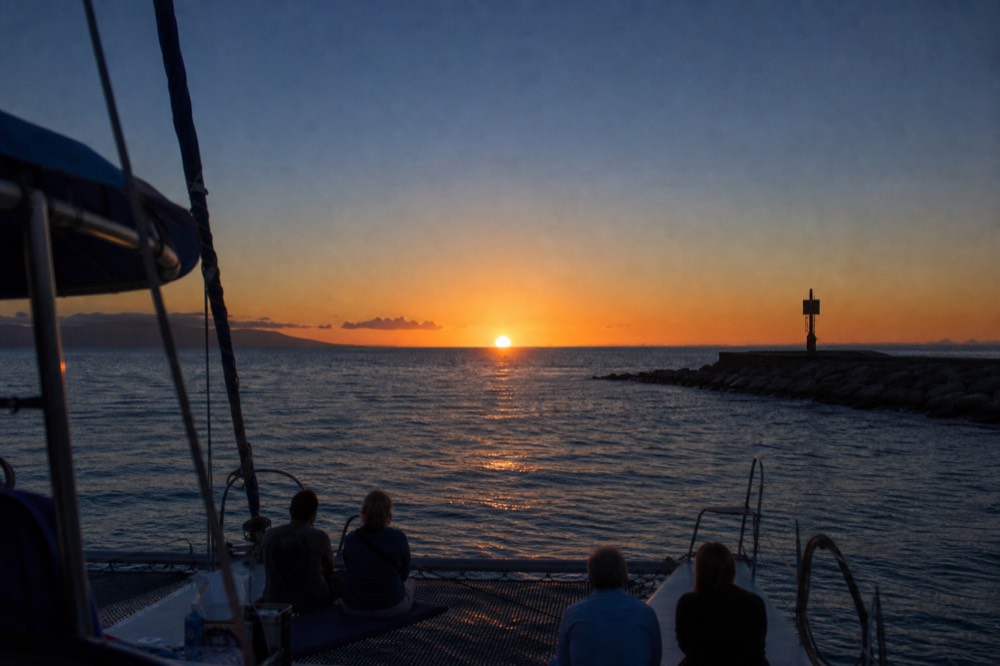
Crews reposition and occasionally run late, because the alternative is docking before the best part. Weather cancellations are decided by wind and sea state rather than cloud, and every boat in the fleet offers free cancellation, typically to 24 hours before departure, with one operator at 48.
Two things can go wrong with a timed sunset product, and only one of them is a real problem. The first is cloud, which is not a cancellation trigger and should not be. An overcast evening still delivers a sailing, and a horizon bank frequently produces better colour than a clear sky does. The second is wind and sea state, which is what actually cancels a departure, and that call gets made from the marine forecast rather than from the window.
Maalaea is the harbor where this matters most. Trade winds funnel across the isthmus between the two mountain masses and make it one of the breeziest harbors in the state through the afternoon, though it typically eases toward sunset, which is exactly when the boats are out. Current conditions are published in the NWS Hawaii coastal waters forecast.
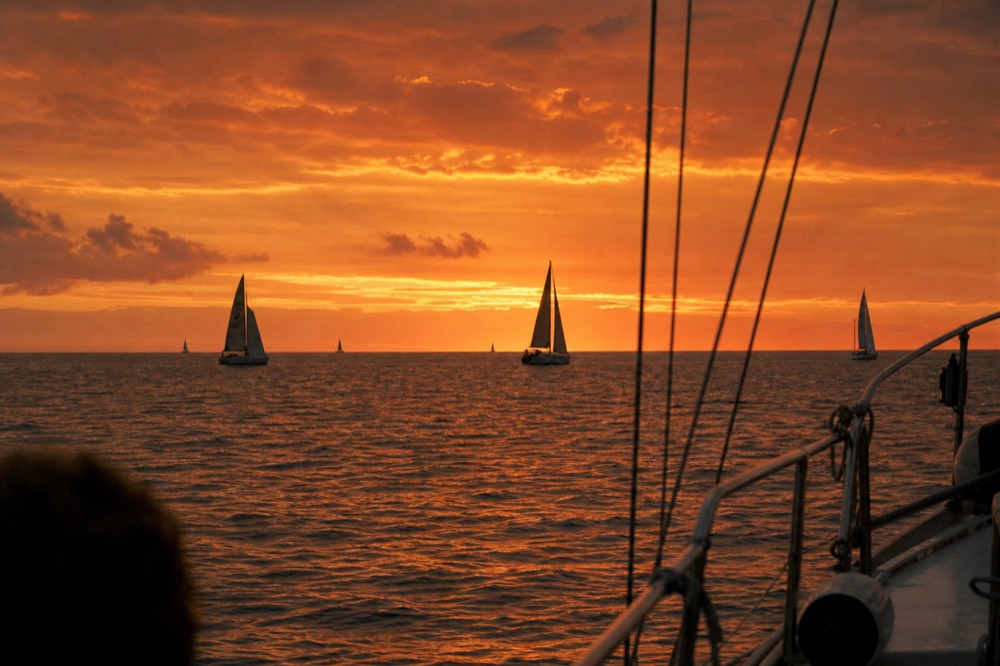
The other half of the answer is that a good crew treats the timetable as a guide. One traveller who sailed out of Maalaea in August 2026 described exactly that: "Brandon made sure we got to see the sunset from the best location and apologised for getting us back later than 7 (not an issue at all!!) as he didn't want us to miss it," wrote Ruth. A return time that slips ten minutes because the captain held position for the colour is the system working properly, and it is one more argument for not booking a 7:30pm table in July.
Common questions about sunset timing on Maui
The short answers: no daylight saving anywhere in Hawaii, the earliest sunset is in late November rather than December, the sun takes about two minutes to set, and arriving 45 minutes before departure is right at every departure point on the island.
Does Hawaii change its clocks?
No. Hawaii observes no daylight saving time, so the sunset column above holds all year without adjustment. That also means the time difference between Maui and the mainland changes twice a year even though nothing on Maui moves, which trips up people scheduling calls home.
Why is the earliest sunset in November rather than December?
Because sunset time and day length do not peak on the same date. The shortest day is the December solstice, but the earliest sunset arrives about three weeks earlier, on a plateau from roughly 21 to 30 November at 5:44pm. The mornings keep getting darker after that while the evenings have already started stretching.
How long does the sun take to actually set?
About two minutes from the moment the disc touches the horizon to the moment it is gone, at this latitude. That is faster than most visitors expect and it is why crews call out the last few minutes. Colour then continues for another twenty minutes or more.
How early should you arrive for a sunset sailing?
Forty-five minutes before departure at the Kaanapali beach loadings, where boarding involves wading out and there is no dock to wait on. Thirty to forty-five minutes at Lahaina and Maalaea, where parking is the variable rather than the boarding. The beach-loading departures at Kaanapali explain what that looks like in practice.
Is sunset better in summer or winter on Maui?
Winter, marginally, on colour, because horizon cloud is more common and underlit cloud is what produces strong colour. Winter also brings humpbacks. Summer wins on warmth, on the length of the evening afterwards, and on how comfortable the deck feels once the sun is gone. There is no bad month.
What should you wear if the sailing runs past dark?
A layer, without exception, whatever the month. Apparent temperature on a moving boat drops well below what the same evening feels like on shore, and it happens fast once the sun is down. How to dress for the temperature drop covers it by month and by boat type, and the full lineup by harbor and price puts the twenty boats side by side.